
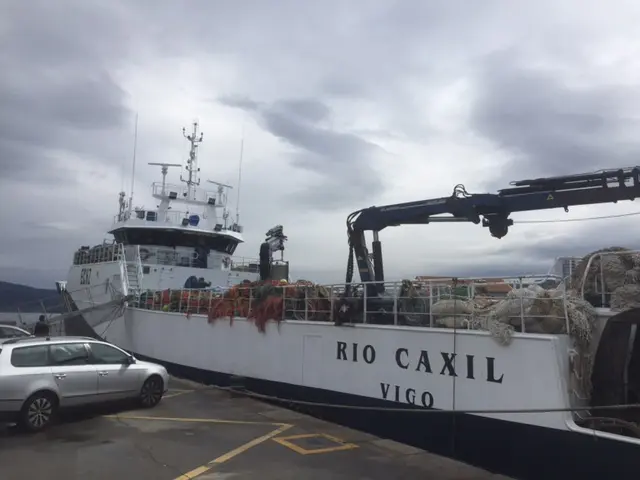
In spring 2016, the Spanish trawler Rio Caxil began trials on a package of Scanmar technology, and the results have been impressive.
Built in Nodosa, Marín in Spain in 2004, the 50.5 m Rio Caxil is an impressive looking fishing vessel, similar to the typical and very popular Gran Sol design with a forward wheelhouse and a long working deck leading back to a stern ramp for hauling the bag on board.
A freezer stern trawler undertaking fishing trips of between 50 and 80 days, depending on the seasonal areas of operation and the fisheries targeted, the vessel is powered by a Wärtsilä 1,400 hp main engine. Using trawl gear manufactured by Galfood, complemented with Injector trawl doors (with Viking doors in reserve), the Vigo-based vessel has per-trip quotas for a range of species, including halibut (200 tonnes), redfish or gallineta (230 tonnes) and skate or raya (50 tonnes).
The amount of quota varies with how much the ship owner can source for leasing or buying, so the amount allowable for Rio Caxil can vary greatly from trip to trip and season to season. The aim is to catch approximately 500 tonnes overall per trip, landed at home in Vigo or occasionally in the port of Cangas. As in most countries, fish prices fluctuate greatly from month to month. Based on this year’s trend, the average prices for Rio Caxil’s landings are approximately €6/kg for halibut, €2.50/kg for redfish and €4/kg for skate.
“Now I can immediately see when something is not right, such as a trawl door falling on its side while we are towing, and I can easily fix it.”
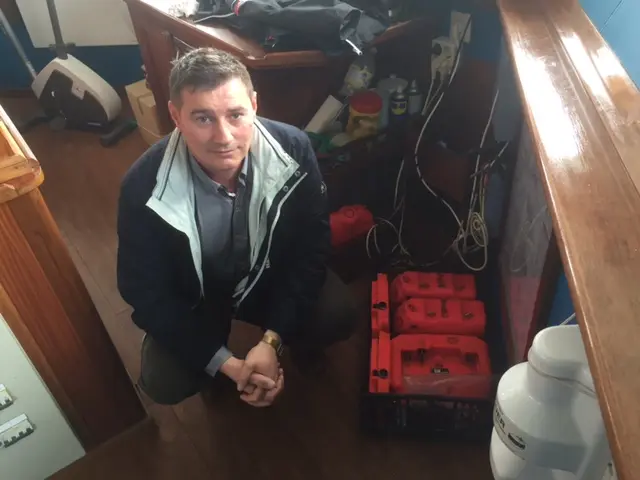
With such long trips at sea part of normal operations, skipper Roberto Sotelo has a large crew of experienced personnel on board: 22 men, two on the bridge, four in the engine room, two in the galley and 12 deckhands.
Technology upgrade
After previously relying on basic Scanmar HC4 trawl door sensors coupled with a standard trawl sounder system, the installation and trials of a new state-of-the-art Scanmar package represented a sharp learning curve, with pleasing results for Rio Caxil and skipper Sotelo.
The upgrade did not come without challenges in resolving some minor configuration problems. After Scanmar experts worked hand in hand with the Rio Caxil team, the new suite of SS4 trawl door sensors, the SS4 Catch system and the highly popular TrawlEye are all bringing increased performance for the vessel, particularly in the redfish fishery, with the halibut fishery yet to be fully tested.
Door sensors
Skipper Roberto Sotelo says he can already see many advantages with the new trawl door sensors, in particular the new angle functionality. “Now I can immediately see when something is not right, such as a trawl door falling over on its side, and I can fix it. I can easily correct any problems with the doors using the winches, and save towing time that would otherwise be completely wasted. In the past I would not have had the information, and I would have been unaware that I needed to take action,” he said, adding that he is now better equipped to know that the trawl gear is fishing in the correct position and shape, which helps improve the vessel’s catch efficiency.
TrawlEye
Roberto has used the TrawlEye for redfish, a 400 m depth fishery, but not yet for halibut, a more demanding 800 to 1,300 m depth fishery. “So far, in the redfish operations, I could clearly see through the TrawlEye when fish entered the net and their position in the trawl opening, and I can easily adjust the trawl opening to be more efficient. For example, if I see that the fish is located between 1 and 5 m and the opening is 5 m, I can modify the mouth opening to be more efficient,” he said, adding that the improved and increased lifetime of all the sensor batteries is now second to none.
Catch sensors
Roberto Sotelo has been pleasantly surprised by the high quality of the catch sensor data. In the redfish fishery, if the fish are in high density shoals, the cod end can fill up quite fast. High volume catches are always welcome, but there is a point where too much volume reduces the quality of the individual fish due to impact pressure in the cod end. The onboard processing line is also a factor: the aim is to catch enough to keep it busy, but not so much that excess fish has to wait in bulk for processing.
“Having accurate catch sensors means that I can watch how much volume is travelling back through the bag to the cod end at all times. Approximately ten tonnes is the ideal volume, both to maintain quality and to make the most of the processing line. With the catch sensor located in the correct place in the trawl, I know when the ten-tonne target has been reached and it’s time to haul,” he said. Another benefit: if the fish are not in the area the vessel is trawling, he doesn’t have to wait for the result of a six-hour tow, because the catch sensor keeps reporting how much, or how little, fish is coming into the net, saving time and fuel.