
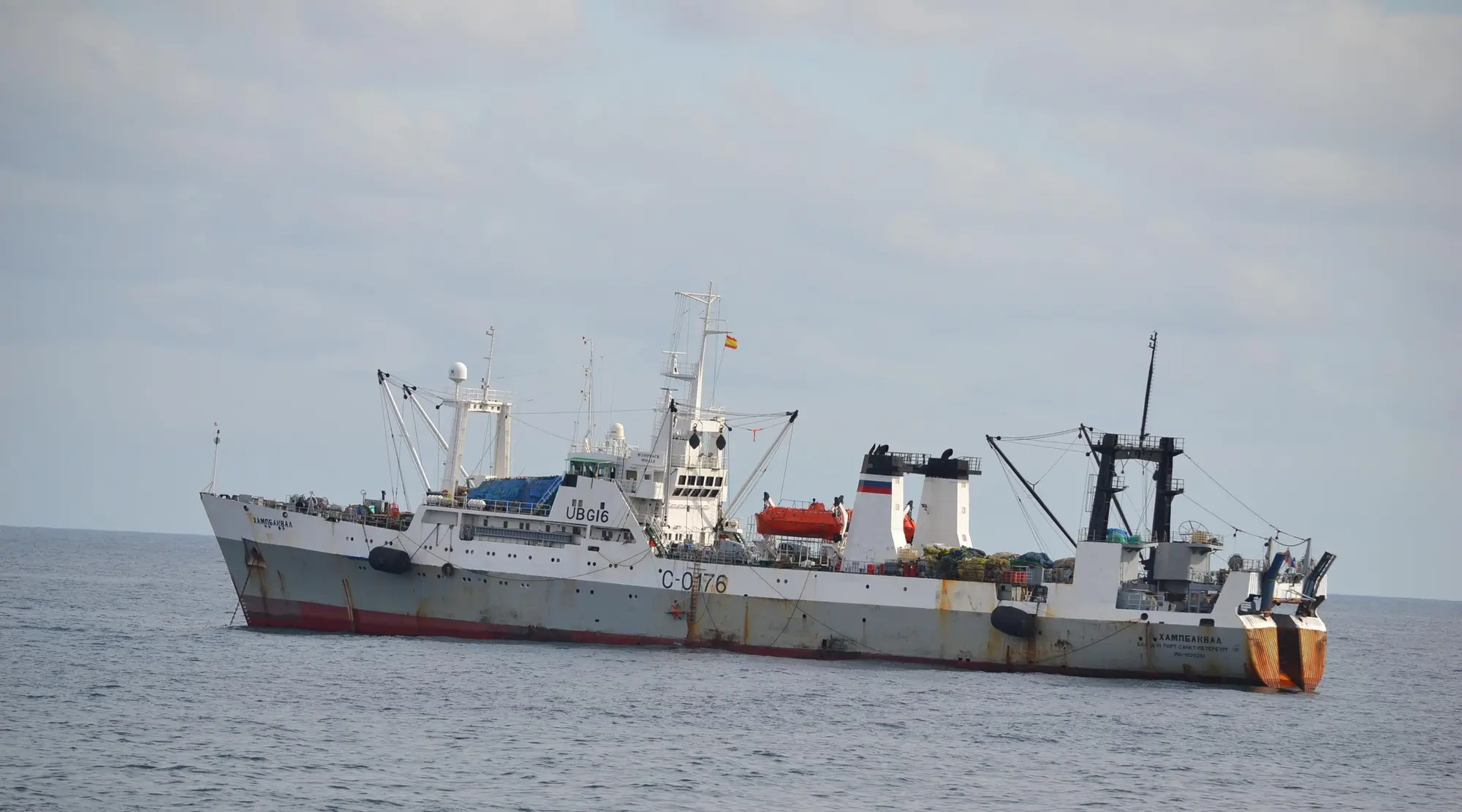
The 105 m Russian trawler Humpback Whale is making a significant improvement in trawling efficiency with the ScanBas system from Scanmar.
While much of the recent news has focused on the latest trawl technology from Scanmar, with high-spec upgrades of various sensors and systems, the reliability of Scanmar’s existing products, operated in combination with newer versions in fleets across the world, shows the difference a company’s dedication to R&D in producing quality technology can make.
One vessel reaping the benefits of this technology is the impressive Russian-flagged distant water trawler Humpback Whale. Built in 1996 at Nikolaev Shipyard, the BATM-class (big automated freezer trawler) vessel has an overall length of 105 m, a gross tonnage of some 4,407 tonnes, and a main engine of 8,162 hp.
Working trips of three to four months at sea, with trawls of two to four hours between hauls, Captain Vladimir Petrovich Savkin and his crew of 60 participate mainly in pelagic fisheries (mackerel, horse mackerel and sardine) in the waters of Morocco, Mauritania, Guinea-Bissau and Angola, where they are unlimited by quota restrictions except in Moroccan waters. Using 9 and 10 m² trawl doors from Thyborøn Trawldoors in Denmark, Humpback Whale operates a single pelagic trawl, Sirius-1,2,3, supplied by AquaService in Lithuania.
“Scanmar equipment is absolutely much easier and more reliable than anything I have used before.”
Technology
Humpback Whale uses an original type of ScanBas system with a pair of door height sensors measuring height over the bottom, door sensors for distance, depth and door angles, and four catch sensors. Flow sensors are used to see the symmetry of the trawl and the speed of the underwater current, and a TrawlEye to see the influx of fish in the net and the height, opening and clearance of the trawl.
“Although the Scanmar equipment was only installed on this vessel six months ago, we have already seen a significant improvement in trawl efficiency. We now have more control over the trawl doors and net, and the graphics for pitch and roll angles and depth of the doors are proving especially useful,” said Captain Savkin, adding that the technology also lets them control and adjust the geometry of the trawl, with the system being reliable and stable.
As many skippers across the international catching sector have commented, essential advantages of Scanmar systems include visual control of the trawl doors, the possibility to see the volume and size of fish influx with the TrawlEye sensor, and the possibility to see the filling of the trawl with the catch sensors when fishing at very small depths with the headrope near the surface.
“The historical graphical information is also very useful, as it shows us the behaviour of the trawl doors and net during different periods of trawling, and lets us adjust the trawling gear for specific fisheries and areas,” commented Captain Savkin. He added that the light and sound alarm on the bridge system, which can be turned on and off, is useful in various situations, and that light indicators on the sensors show their charging status, making it simple to see if they need to be charged.
Advantages
“We can now control the geometry and position of the trawl, and when we can track the behaviour of the trawl doors with the historical graphical information from Scanmar, we can adjust them for more effective trawling and react more quickly to any unexpected changes in trawl door positions. The TrawlEye shows us if the fish is coming inside the net, and how effective the fishery is in general: how much of the fish is going inside and how much escapes the net. Meanwhile, the catch sensors show us the filling of the trawl even at small depths, so we don’t need to sink the trawl deeper,” he said, adding that easier control of the trawl and the doors results in time saved in general.
On the quality and longevity of the sensors, the Russian skipper was pleased to report that so far there have been no signs of wear and tear. “We’ve had absolutely no problem with the service and maintenance of these sensors, as they are quite easy to use and keep in good condition, without the need for any technical support,” he said.
Testimony
“All in all, I can say that Scanmar equipment has proven to be a useful investment, which has given us a significant improvement in trawling efficiency and control of the gear. If the equipment continues to perform this well, I will certainly give it my approval for other fishermen,” Captain Savkin said, adding: “What is absolutely positive is that Scanmar equipment is much easier and more reliable in operation than similar systems from other manufacturers. Value for money? We will need more time to give a certain answer, but I think we are almost positive that the answer is a definitive yes.”
Captain Vladimir Petrovich Savkin was born in 1956 and graduated from the Maritime & Engineering University in Kaliningrad in 1980. Since then he has worked his whole life in the fishing industry around Africa and in the South-East Pacific, mainly on large and middle-sized trawlers, including Moonsund, Prometey, Sprut, Pulkovskiy Meridian and now Humpback Whale.