
With environmental, climate change and marine resource issues at the forefront of concern for the modern world, many leading nations are investing heavily in state-of-the-art icebreaker research vessels. They will be capable of dealing with the harshest conditions on the planet, so scientists can study a wide and diverse range of ecosystems, habitats and resources globally. Here we look at just three of the most exciting of this new breed of vessels.
Australia
Considered by the Australian Government as a “once in a generation investment”, the new 160 m icebreaker research vessel is the centrepiece of the AUD 1.9 billion (€1.2 bn) Australian Antarctic Strategy 20-Year Action Plan launched in 2016. Including the design, build and 30-year operational and maintenance lifespan of RSV Nuyina, this is the single biggest investment in the history of Australia’s Antarctic Program.
Due to make its maiden voyage to Antarctica in 2020/21, Nuyina has been designed to support scientific research that answers the critical questions of today, but it must also cope with future research demands over the ship’s 30-year lifetime, some of which are currently unknown. To ensure this, the scientists involved in the design consultation had to do a bit of crystal ball gazing, considering what the science of the future could look like and what capabilities the ship would need to support it. With a moon pool to deploy autonomous vehicles and oceanographic equipment, RSV Nuyina can also:
- break 1.65 m thick ice at a continuous speed of 3 knots
- cruise efficiently at 12 knots, with a maximum speed of 16 knots
- handle sea state 9 (waves over 14 m)
- handle Beaufort 12 winds (hurricane)
- cope with air temperatures as low as −30 °C and up to 45 °C
- support voyages of up to 90 days
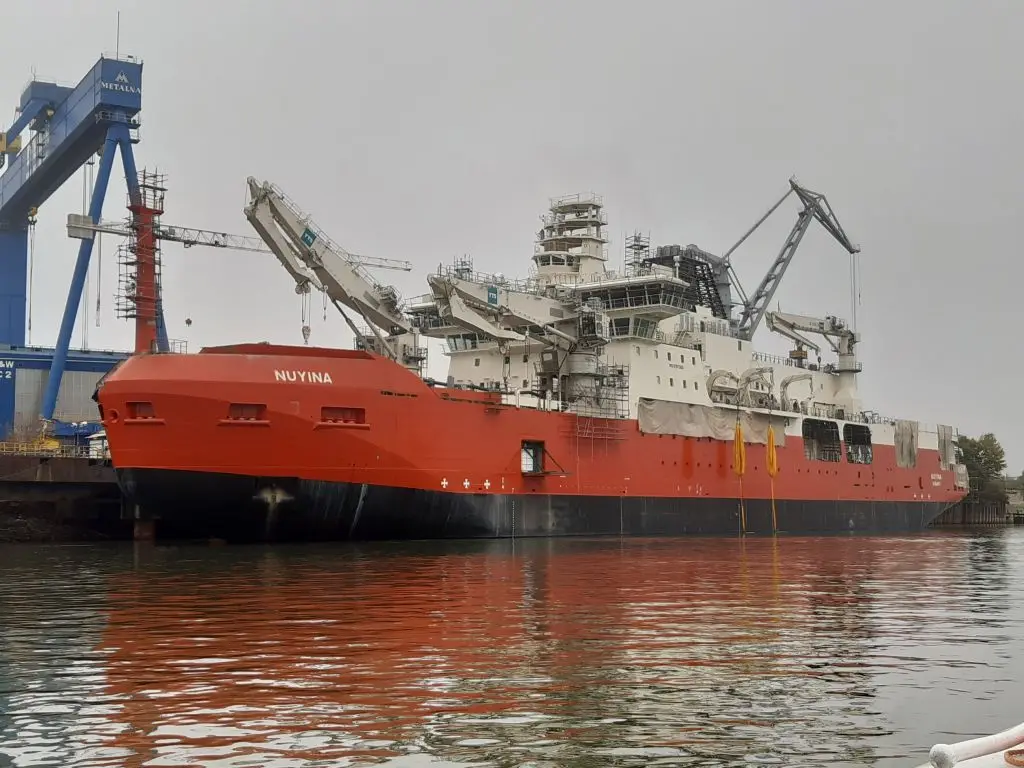
The ship will be the main lifeline to Australia’s three Antarctic research stations and its sub-Antarctic station on Macquarie Island, and will support Australia’s leadership role in Antarctic and Southern Ocean scientific research. Nuyina is the only ship in the world with a watertight room, or wet well, to process seawater for krill and other fragile marine organisms, at up to 1,800 litres per minute.
State-of-the-art scientific equipment, including the latest technology from Scanmar, includes acoustic instruments to map and visualise the sea floor and organisms in the water column, and instruments to measure atmospheric gases, cloud properties, wave heights and ice conditions. As well as its own helicopters, the vessel has a Silent R acoustic rating at 8 knots, which minimises noise radiating from the ship’s two diesel engines (19,200 kW total) for icebreaking and two electric motors (7,400 kW total) powered by diesel generators for silent operations.
The word nuyina means southern lights in palawa kani, the language spoken by Tasmanian Aborigines today. It is pronounced “noy-yee-nah”, and the name recognises the long connection Tasmanian Aboriginal people have with the southern lights (aurora australis).
United Kingdom
The project for a state-of-the-art new 129 m research icebreaker for the UK almost got off to a bad start, as the public vote to find a name for the new vessel almost resulted in the now infamous name Boaty McBoatface. Common sense finally prevailed, and the new vessel carries the name of the distinguished and globally respected Sir David Attenborough.
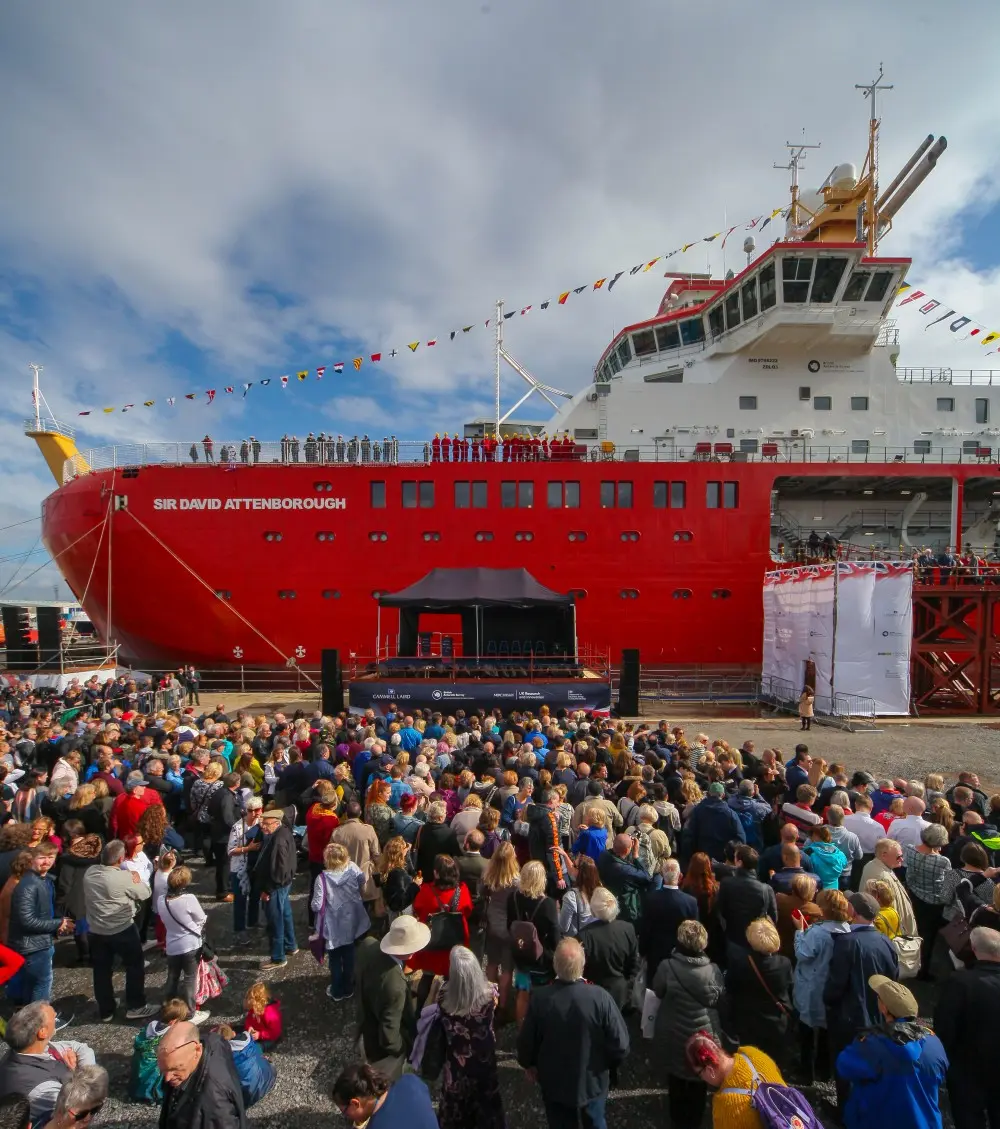
Operated by the British Antarctic Survey (partner NERC-BAS), RRS Sir David Attenborough is a multipurpose ice strengthened research vessel built to the new PC4 Polar Code requirements. With the Antarctic and Arctic oceans as its main scientific regions of operation, the vessel has an endurance of 60 days and carries some 90 persons, 60 of them scientists, in 40 single and 25 double cabins. Its primary role is as the British Antarctic Survey’s logistics and research platform, and it is available for NERC-funded Arctic science for 60 days per year.
With a vast range of scientific facilities and its own helicopter deck and hangar, RRS Sir David Attenborough has configurable interior labs, temperature-controlled spaces and a suite of containerised labs. The moon pool in the CTD hangar allows in-ice measurements and sampling that are otherwise difficult in the ice, and the vessel can support the full range of ocean-based science disciplines, with a full suite of acoustics including both deep ocean and shallow water swath systems.
Norway
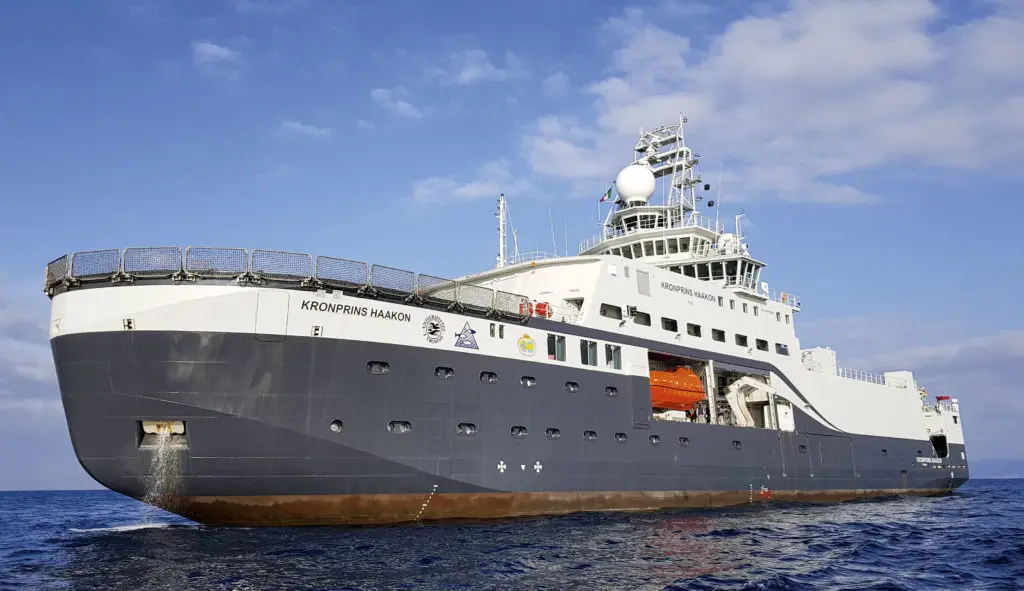
Based in Tromsø, the new 100 m × 21 m icebreaker research vessel Kronprins Haakon is formally owned by the Norwegian Polar Institute, while the Institute of Marine Research has operational responsibility and the Arctic University of Tromsø is its main user. Equipped with state-of-the-art scientific instrumentation, the NOK 1.4 billion vessel is classed as an icebreaker for year-round operation in ice-covered waters, and as a research vessel it is seen as a valuable continuation of Norwegian research traditions in the Arctic. Among its many assets, Kronprins Haakon has:
- PC 3 icebreaker class, for year-round operation in ice-covered waters
- state-of-the-art scientific instrumentation
- moon pool and ROV, AUV and helicopter operations
- accommodation for 17 crew and 35 scientists
- endurance of 65 days at cruising speed
- a cruising speed of 15 knots, and the ability to break through ice up to one metre thick
Kronprins Haakon will monitor the environmental and climate state of both the Arctic and the Antarctic.