
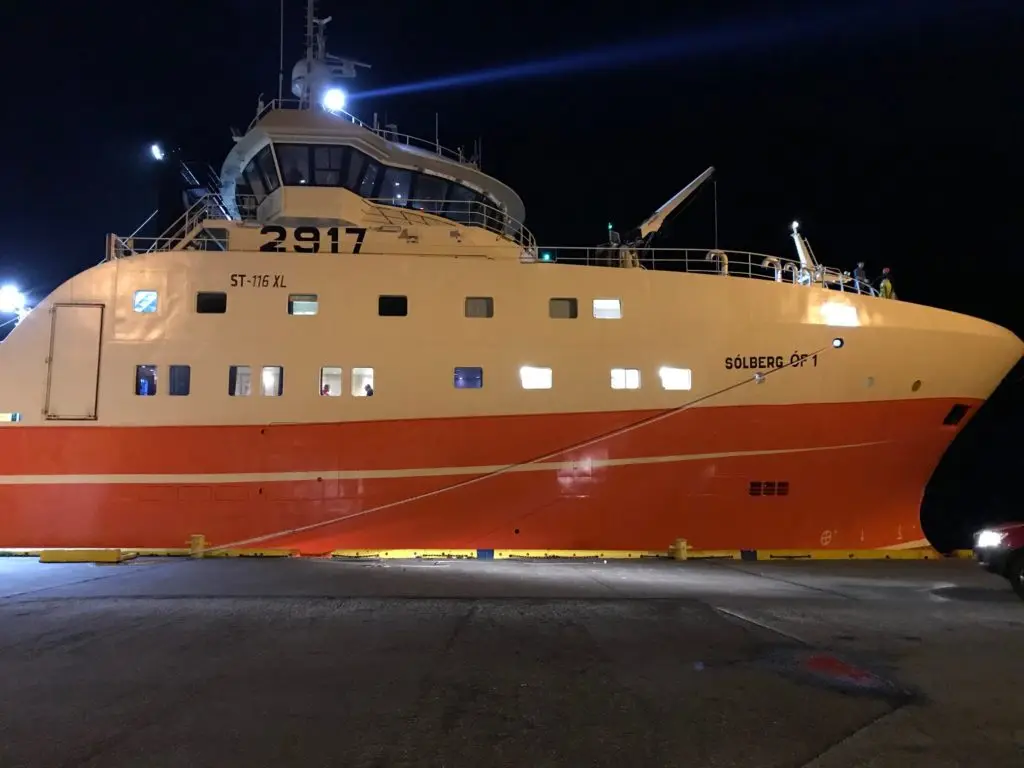
One of Iceland’s top demersal trawlers is the 80 m Solberg, and Scanmar’s Icelandic agent Thorir Matthíasson joined the vessel for a trip at sea to give the skipper and crew operation training.
Built at the Thersan shipyard in Turkey and delivered to the owners Rammi hf. in Siglufjördur, Iceland in April 2017, the impressive Solberg has an overall length of 80 m and is powered by a Wärtsilä 6,310 kW main engine. Working four-week trips with its 32-man crew, Solberg operates various types of fishing, including single and twin rig (double) trawling, using mainly trawl gear from Hampidjan in Iceland combined with trawl doors from Denmark’s Thyborøn Trawldoors: Type 12 bottom trawl doors of 5.6 t each and 13 m² in area. Operating in the main fishing areas of north west Iceland, between Greenland and Iceland, the main target species are cod, haddock, redfish and saithe.
With all its seafood products for export and the main market being the UK, Solberg must operate not only economically but also as sustainably as possible. The vessel is therefore fitted with a full processing filleting factory, extending to a state-of-the-art fishmeal facility and fish oil factory. All fish offal and waste is used for fishmeal and fish oil, and nothing is thrown back to sea after processing. The vessel’s processing and production capacity is approximately 50 tonnes per day, plus the resulting fishmeal and fish oil.
The Scanmar angle
“During the five days I spent last autumn on board Solberg, my focus was on teaching the skipper, Sigurbjörn Kjartansson, the operation of the new SB365 system, and instructing the deck crew on the importance of the location of the sensors on the trawl for best results,” explains Thorir Matthíasson.
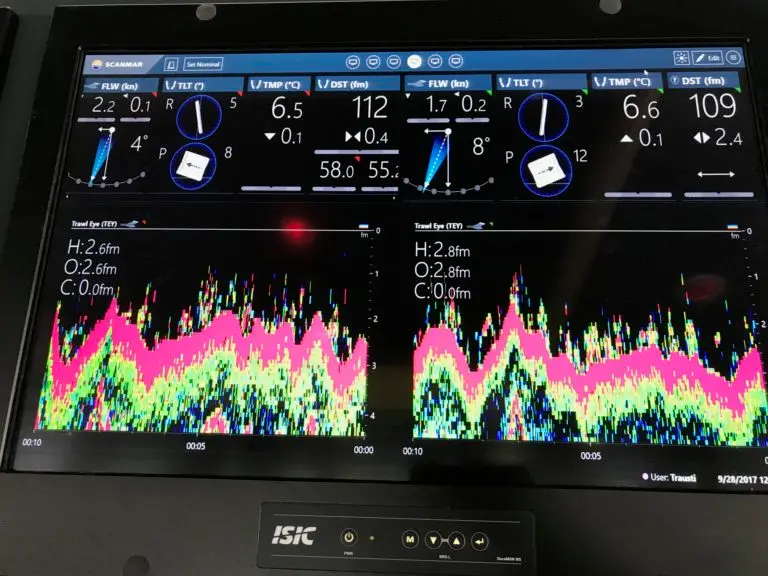
Solberg is geared up with the latest technology in trawl science, with a full ScanBas 365 system with SS4 double distance door and clump sensors with all functions, including door angle, depth, temperature and distance, TrawlEyes, SS4 Catch sensors with angle functions, and Flow sensors.
Thorir Matthíasson’s work and the performance of the Scanmar systems resulted in very positive feedback from those on Solberg. Having seen the system work fantastically well at sea, skipper Kjartansson says that he very much likes how user-friendly the operation is, particularly the function that allows him to create his own preferred screen layout and settings and save them to his own private login. If someone changes the layout, he can return to his preferences with a single click.
“My focus was also to teach the deck crew about the sensors and how to work on them through the QBC-X1 programming and charger unit,” Thorir explained, adding that this includes knowing about the easy-to-change FID code and how to adjust the power settings to always get the longest battery capacity for each sensor.
The deck crew were impressed that the battery lifetime on the SS4 sensors is very long. On a trip of four weeks they never needed to recharge the SS4 Catch sensor once, and the door sensors needed to be charged only one single time during the entire trip. While remaining on the doors, they took only one hour to fully charge to 100%.
“By adjusting the wire, sometimes by just a few metres or fathoms, you could see the difference immediately on the Flow sensor box.”
“We also spent a good time on using the Flow sensors,” Thorir commented. “When double trawling, we used Flow sensors on both trawl headlines, and it was very interesting to clearly see the flow speed and flow angle into the trawl. What was also very interesting was to observe how easy it was to keep a good and direct flow straight into the trawls by adjusting the wire length on the port or starboard side, or the clump. The Flow sensor is probably the most underestimated sensor on the market, transmitting such important information as flow speed and flow angle into the trawl.”